
Most people have felt it before, even if they never tried to explain it.
You walk into a forest after a stressful day and something changes almost immediately. Not dramatically. Not all at once. But the body softens a little.
Breathing slows down.
Thoughts become less sharp around the edges.
The nervous system seems to loosen its grip.
And for a moment, things feel quieter inside.
We often describe this feeling emotionally.
The forest feels peaceful. Grounding. Calm.
But maybe part of the reason we feel better around trees is much simpler than we think.
Maybe the body recognises something there that modern life rarely offers anymore: a space that does not constantly demand our attention.
Cities are built around stimulation.
Notifications. Traffic. Artificial light. Screens. Sudden sounds. Endless movement. Even when we try to rest, the nervous system often remains slightly alert, scanning and filtering information all the time.
The forest is different.
Nothing flashes.
Nothing competes aggressively for attention.
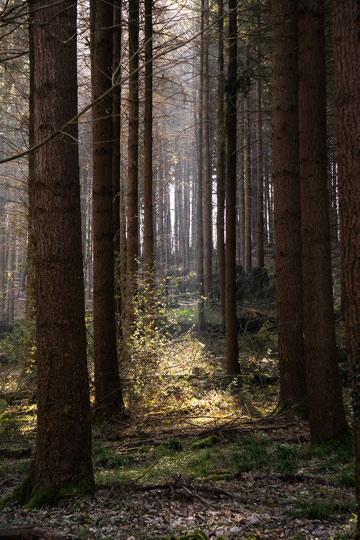
The sounds are layered, but soft. Wind moving through branches. Birds somewhere in the distance. Leaves shifting under your feet.
Your attention changes there. You stop forcing focus.
Researchers sometimes call this “soft fascination” — the kind of attention nature creates without exhausting the mind. You notice things, but gently. The shape of a branch. Light moving across bark. A patch of moss beside the path.
The mind stays engaged, but it no longer feels overloaded.
And honestly, most people already know this feeling long before they ever read about it. You feel it when you realise you haven’t checked your phone for twenty minutes. When your shoulders drop without noticing. When walking stops feeling like a task and starts feeling rhythmic again.
There is also something deeply regulating about trees themselves. Forests are structured environments. Repetition exists everywhere — vertical trunks, familiar textures, natural patterns that repeat without becoming chaotic. The nervous system tends to relax in places that feel coherent and predictable.
Modern environments are often fragmented. Loud colours, advertisements, interrupted movement, too many decisions at once.
The forest asks much less from us. Not because it is empty, but because it is balanced. Even visually, forests rarely force the eyes to work as hard as urban spaces do. There is depth, but not pressure. Complexity, but not overload. Maybe this is why people often say they can finally think clearly while walking through trees. Not because the forest gives them answers. But because it reduces the noise enough for thoughts to settle naturally.
Studies about forest bathing and nature exposure have found measurable physiological changes connected to time spent in forests. Lower cortisol levels. Reduced stress markers. Increased parasympathetic nervous system activity — the part of the nervous system associated with rest and recovery.
But honestly, before science explained it, people already sensed it intuitively. You can feel it in the way conversations change during a walk in the woods. How silence becomes more comfortable there. How even sadness feels less sharp when carried beneath trees. Nature does not necessarily remove difficult emotions. But it often gives them more space to breathe.
There is also something important about the pace of forests.
Trees do not rush.
Nothing in the forest seems concerned with urgency.
Growth happens slowly. Quietly. Sometimes invisibly for long periods of time.
And when we spend time there, even briefly, the body sometimes begins to mirror that rhythm.
Not because we consciously try to slow down.
But because the environment itself encourages it.
A forest path rarely feels like a place for multitasking.
You walk.
You notice.
You adjust to the pace beneath your feet.
Maybe this is part of why slow walking feels so different outdoors than it does in a city street or on a treadmill.
In forests, movement stops being performance.
It becomes presence.
Even the sensory experience around trees is different.
The air feels cooler. Softer.
Light filters instead of glaring directly.
Sound travels differently.
Nothing arrives too fast.
For an overstimulated nervous system, that matters more than we sometimes realise.
Many people are not necessarily exhausted because they are weak or unmotivated. They are exhausted because their attention rarely gets a chance to rest.
The modern world rewards constant alertness.
The forest does not.
And maybe this is why people return to trees again and again, even when they cannot fully explain why.
Not because forests are magical.
Not because nature instantly heals everything.
But because around trees, the body often stops bracing itself quite so hard.
The nervous system no longer has to process hundreds of unnecessary signals every minute.
There is less defending.
Less filtering.
Less resistance.
And in that small reduction of internal pressure, something important becomes possible again:
Breathing deeply.
Thinking clearly.
Feeling present.
You do not need a remote mountain forest for this.
Sometimes it happens on a short walk through a local park.
Sometimes beside a single old tree.
Sometimes during ten quiet minutes before going home.
The effect is rarely dramatic.
But maybe that is exactly the point.
Nature does not usually overwhelm us into calmness.
It invites us there slowly.
And perhaps that is why we feel better around trees.
Not because they demand anything from us —
but because, for a little while, they allow the nervous system to soften back into a more natural rhythm.
Further Reading & Research
This article was inspired by research on:
- forest bathing and stress reduction
- Attention Restoration Theory
- nervous system regulation in natural environments
- studies on cortisol and parasympathetic activity during nature exposure
Selected sources include research published through PubMed and studies on nature-based stress recovery.